Agentic Workflows, Explained With a Real Enterprise Example
An agentic workflow is a process where an AI model plans and carries out the steps toward a goal, choosing its tools as it goes. How it differs from automation and a chatbot, two examples from my own work, and six tests for picking your first one.

An agentic workflow is a process where an AI model works toward a goal by planning the steps, choosing which tools to call, reading the results and deciding what to do next. A normal automation follows steps someone wrote in advance. A chatbot answers one question at a time. An agentic workflow is given a job and works out the steps itself.
That definition is easy to agree with and hard to use. So here are two agentic workflows I know firsthand, one I am piloting at work and one in a product I built on my own, and the tests I would use before starting a third.
Automation, chatbot or agentic workflow
The difference is who decides the next step.
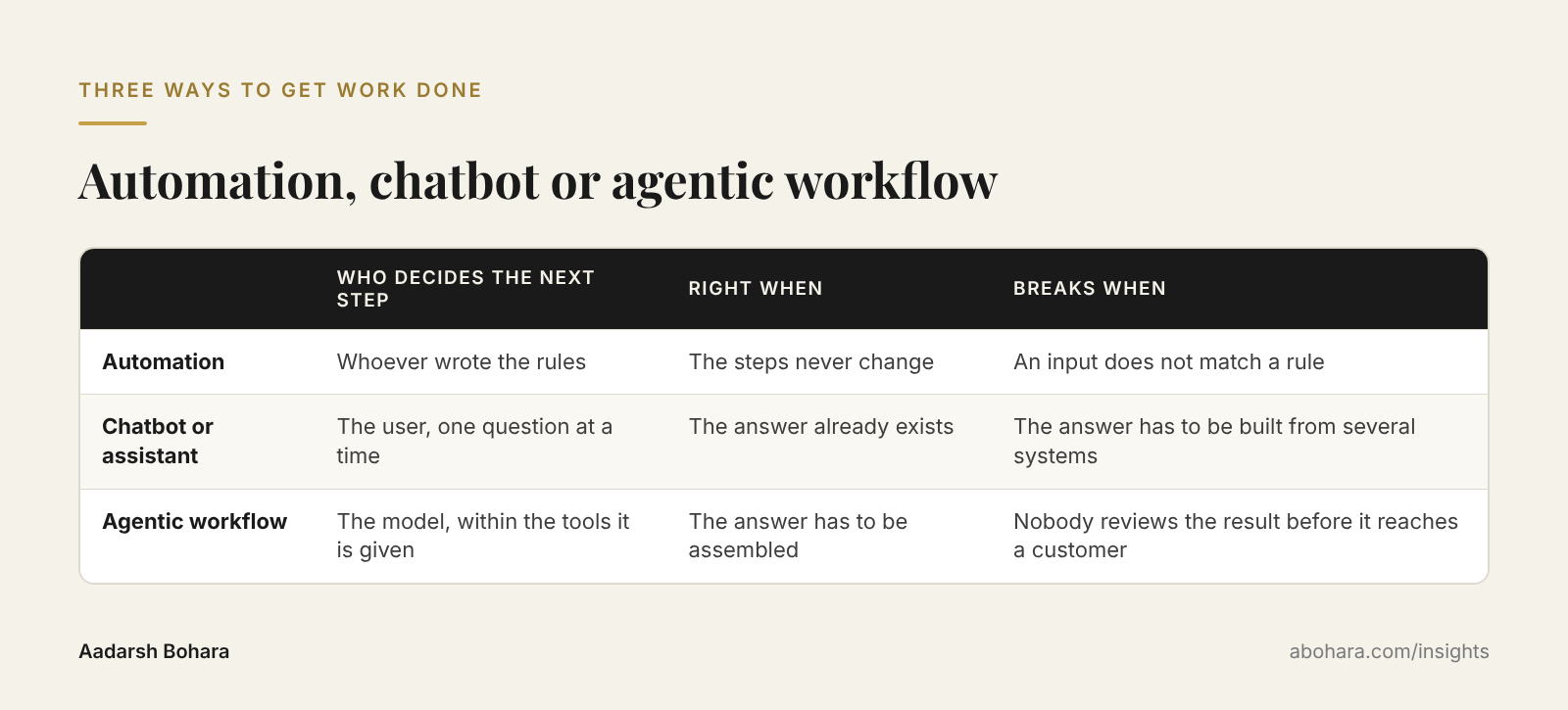
An automation is right when the steps never change. A chatbot or assistant is right when the answer already exists somewhere and the job is to find it. An agentic workflow earns its place when the answer does not exist yet and has to be assembled from several systems.
A short rule helps when choosing between retrieval and an agent. If the answer exists, retrieve it. If it has to be built, that is work for an agent.
A real example: assembling an entitlement setup
Where I work today, more than 40 delivery specialists turn each new customer order into a working entitlement setup: the company account, the group for that contract, the license with its product packages and customizations, the group assignments and the subscription enrollment links. The work takes two to five hours per order.
None of that information is new. It already exists in the order. A skilled person spends an afternoon moving it by hand.
The agentic workflow I am designing and piloting does that assembly.
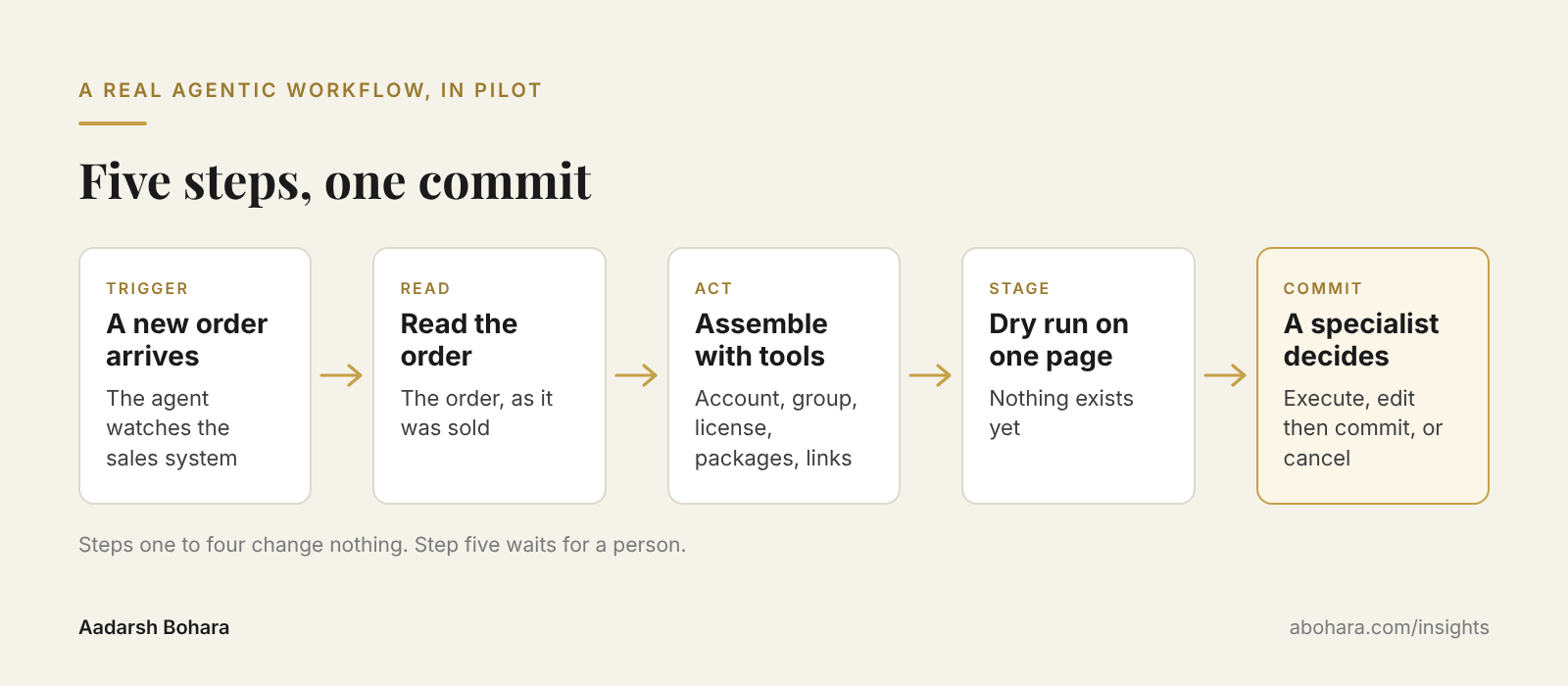
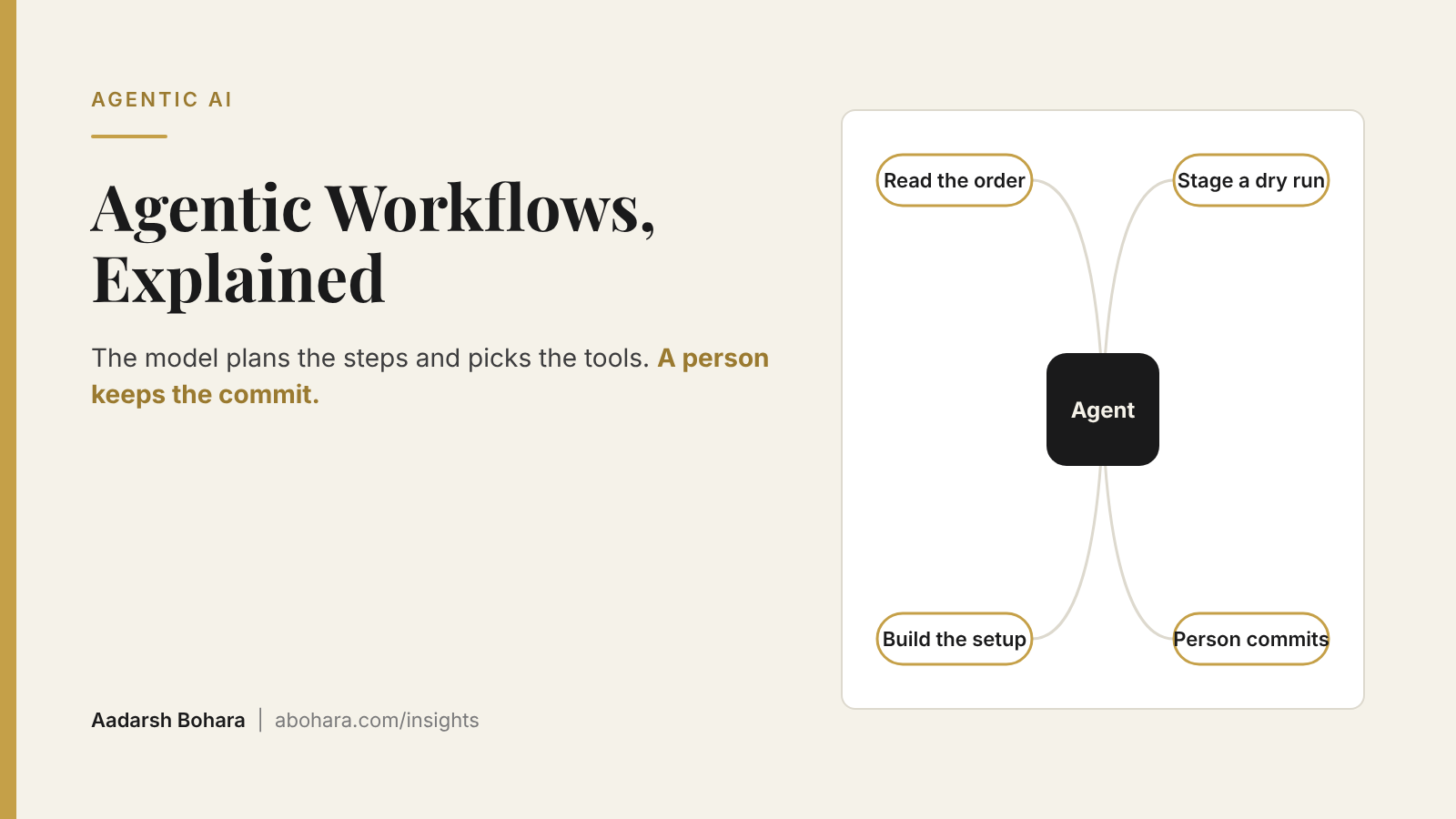
- Trigger. It watches the sales system for new orders.
- Read. It reads the order.
- Act with tools. It finds the right company account or drafts a new one, then drafts the group, the license with its packages and customizations, the assignments and the enrollment links.
- Stage. It puts the complete setup on one review page as a dry run. Nothing exists yet.
- Commit. A delivery specialist executes it as staged, edits it and then commits, or cancels it.
Steps one to four change nothing. If the agent gets something wrong, nothing has happened. Step five changes what a customer can access, so it waits for a person.
I tune it layer by layer against what a specialist would have produced by hand. That is the benchmark that matters most here, because a draft that needs rework helps nobody.
It is a pilot, so I have no result to report yet. I watch three numbers: time per order, the edit rate on dry runs, and specialists approving without reading. The last one is the warning sign. If review turns into a rubber stamp, the safeguard is gone, even when the first two numbers look good.
A second example: an assistant that acts
MindBacklog, a product intelligence platform I built on my own to go deeper on AI product work, has an assistant called Ask Mind. It has 27 tools and sits in a side panel on every page. A user asks for something, the assistant decides which tools to call to read the product’s data, and it proposes a change. It asks for confirmation before it commits anything.
Two lessons from building it apply to any agentic workflow.
Instructions should travel with the tool call. The first version was grounded but shallow. Large instruction templates for each kind of task made the answers better and every run more expensive. The better design is a prompt library the assistant pulls from at the moment it calls a tool, so each call carries only the instructions its task needs.
The agent should gather its own context. Ask Mind pulls context itself, including from Confluence over MCP, instead of waiting for the user to paste in the spec and last quarter’s notes.
The same product also shows where agentic is the wrong choice. Its signal pipeline runs enrichment, quality filtering, classification, clustering and then scoring, in that order, for every piece of feedback. It uses models at several steps, but nothing in it needs to decide what to do next. So it is a fixed pipeline, and making it agentic would only add cost and new ways to fail.
Six tests for your first agentic workflow
The entitlements workflow meets all six, and they are the tests I would apply to any first agentic workflow.
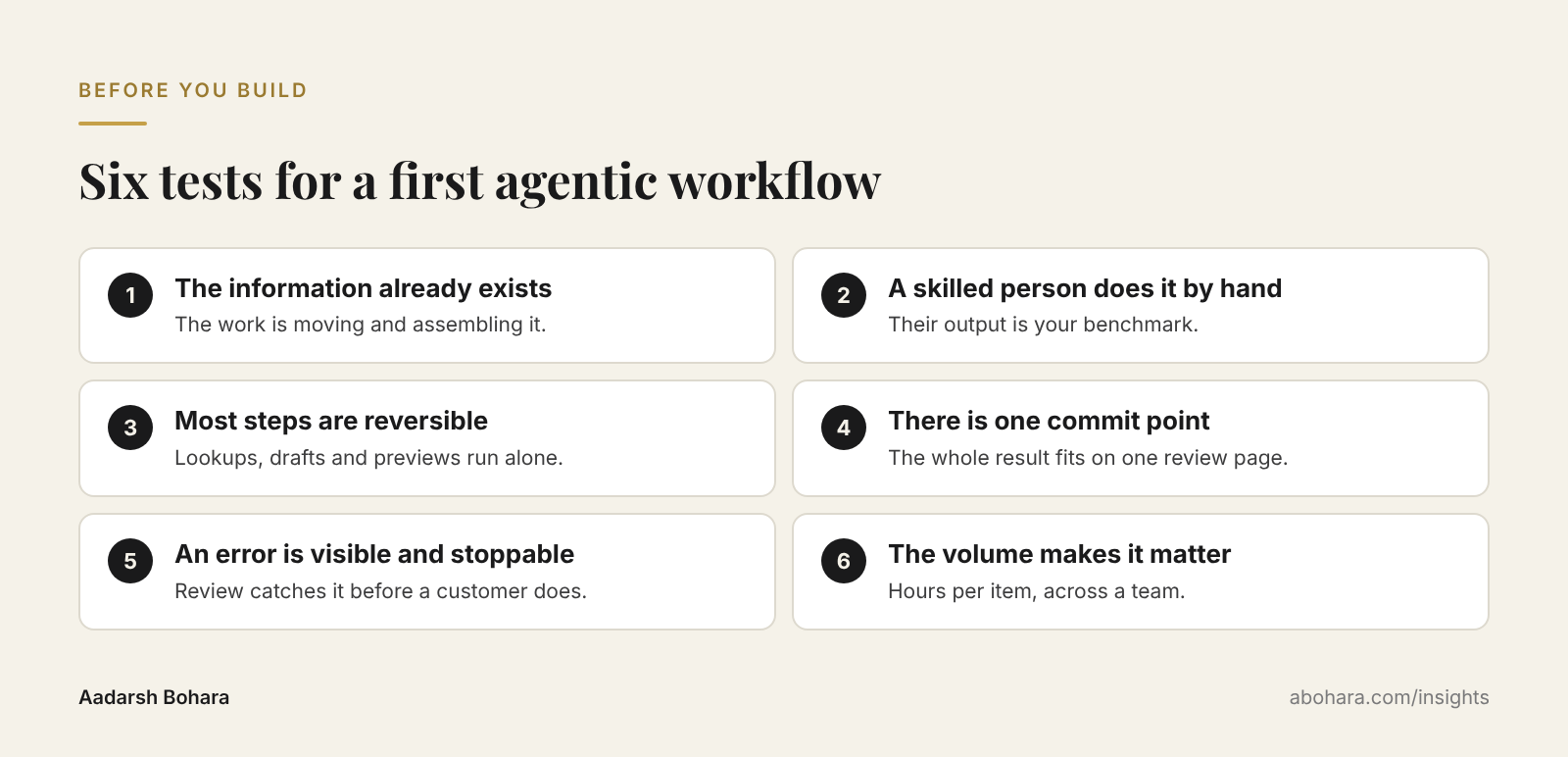
- The information already exists. The work is moving and assembling it, not creating it.
- A skilled person does it by hand today. Their output becomes your benchmark.
- Most steps are reversible. Lookups, drafts and previews can run alone.
- There is one commit point. A person can review the whole result on one page.
- An error is visible and stoppable. The review catches it before it reaches a customer.
- The volume makes it matter. Hours per item, multiplied across a team, is the business case.
If a candidate fails the fourth test, fix that first. An agentic workflow with approvals scattered across ten steps trains people to click through all of them.
Where agentic workflows go wrong
Tools with too much access. Giving the agent a user’s or an administrator’s full access is the easy default. Scope each tool to the actions it needs, and give the agent less than the person it works for.
Approval in the wrong place. A confirmation on every step gets ignored. One clear review at the point of commit gets real attention.
A demo as the benchmark. A clean example in a demo proves very little. Measure against the specialist’s own work on real cases, including the messy ones.
No record. If you cannot say which agent did what, for whom and under which approval, you cannot debug it or defend it to a customer.
What this means for product teams
An agentic workflow is a product decision before it is an engineering one. The model you choose matters less than three calls you make first: which steps run alone, where a person commits, and what the record says.
The agent does the reasoning and the legwork. The person keeps the commit on anything that cannot be undone.