Agentic Entitlements Workflow
An AI agent that assembles a complete customer entitlement setup from an incoming order, then hands the commit decision to a human. In pilot at S&P Global.
Role
Associate Director, Product Management
Industry
FinTech / Identity
Client
S&P Global
Context
Applied AI
01. The Problem
Five Hours of Moving Information That Already Exists
When a new order lands in the sales system, a delivery specialist assembles everything that has to exist before the customer can log in: the company account, the license group for that contract, the license itself with its product packages and customizations, the group assignments, and the subscription enrollment links.
S&P Global products are genuinely complex to entitle. Packages, customizations, tiers, and inheritance rules interact, and the work takes two to five hours per order depending on the company and the contract. The team doing it is more than forty people, working across a 42,000-license estate.
The detail that made this worth automating: none of the information is new. All of it already exists in the order. A skilled person is spending an afternoon moving it by hand.
S&P Global products are genuinely complex to entitle. Packages, customizations, tiers, and inheritance rules interact, and the work takes two to five hours per order depending on the company and the contract. The team doing it is more than forty people, working across a 42,000-license estate.
The detail that made this worth automating: none of the information is new. All of it already exists in the order. A skilled person is spending an afternoon moving it by hand.
02. The Design Decision
The Agent Does Not Execute
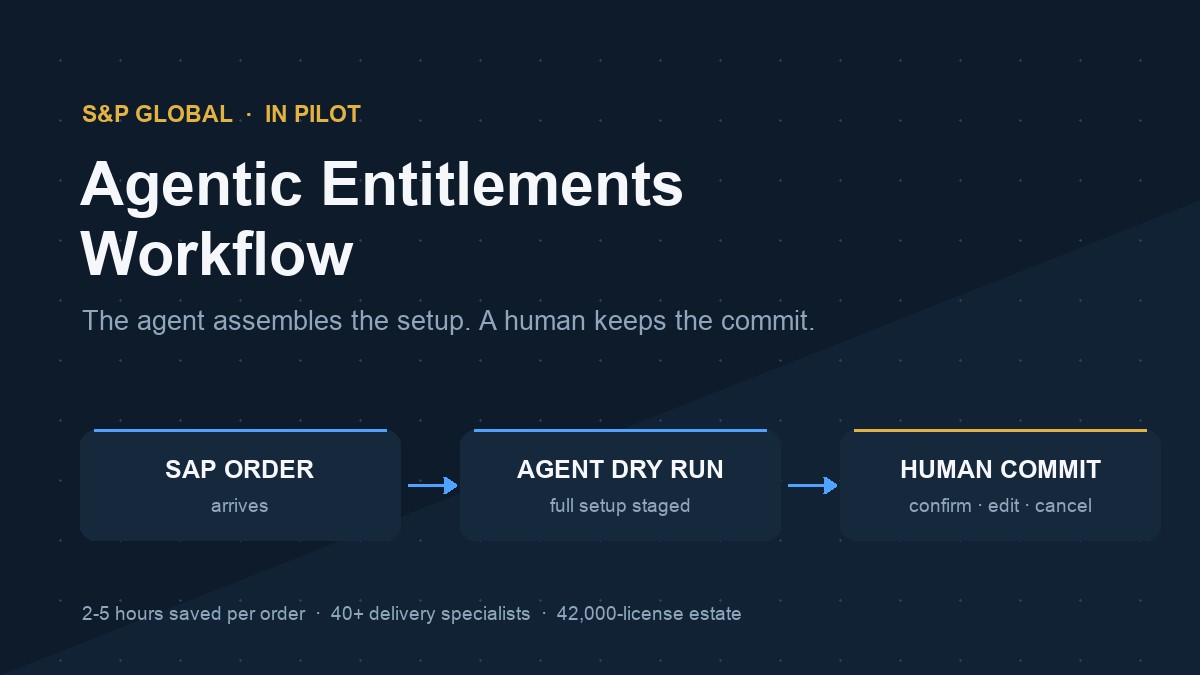
The agent watches the sales system for incoming orders. When one arrives, it reads the order, finds the right company account or creates one, builds the license group and the license with its product packages, completes the group assignments, and generates the subscription enrollment links.
Then it stops.
The entire setup is staged as a dry run on a single review page, where the delivery specialist can confirm it as-is, edit it and then commit, or cancel it. Nothing reaches a customer until a person has said so.
The reason is cost asymmetry. Entitlement errors are visible to customers, sometimes contractual, and there is no quiet undo. A saved hour is worth much less than wrong access in production. So the reversible steps run autonomously, and the one irreversible step keeps a human on the commit. The review page is not a safety wrapper around the product. It is the product, and it is the reason the delivery team was willing to adopt the agent at all.
Then it stops.
The entire setup is staged as a dry run on a single review page, where the delivery specialist can confirm it as-is, edit it and then commit, or cancel it. Nothing reaches a customer until a person has said so.
The reason is cost asymmetry. Entitlement errors are visible to customers, sometimes contractual, and there is no quiet undo. A saved hour is worth much less than wrong access in production. So the reversible steps run autonomously, and the one irreversible step keeps a human on the commit. The review page is not a safety wrapper around the product. It is the product, and it is the reason the delivery team was willing to adopt the agent at all.
03. Tuning
The Benchmark Is the Specialist's Own Work
I have iterated on the workflow layer by layer, tuning each step until the agent's output matches what the specialist would have produced by hand. That is the only benchmark that matters here; a draft that needs rework saves nobody anything.
The health metrics are deliberately boring: time per order, and the edit rate on dry runs. A falling edit rate means the agent is getting things right. The signal I watch for as a warning is specialists approving without reading. If the review step ever becomes a rubber stamp, the safeguard is gone and the design has failed quietly.
The health metrics are deliberately boring: time per order, and the edit rate on dry runs. A falling edit rate means the agent is getting things right. The signal I watch for as a warning is specialists approving without reading. If the review step ever becomes a rubber stamp, the safeguard is gone and the design has failed quietly.
04. Status
In Pilot, and a Principle Proven Twice
The workflow is in pilot with the delivery team, saving an estimated two to five hours per order depending on order and company size.
It is also the second time I have shipped the same rule: agents do the reasoning and the legwork, and a human keeps the commit decision on anything irreversible. The AI co-pilot inside MindBacklog, a product I built independently, stages its changes for confirmation the same way. Implementing the principle twice, in two unrelated systems, is what convinced me it is a design philosophy and not a workaround.
It is also the second time I have shipped the same rule: agents do the reasoning and the legwork, and a human keeps the commit decision on anything irreversible. The AI co-pilot inside MindBacklog, a product I built independently, stages its changes for confirmation the same way. Implementing the principle twice, in two unrelated systems, is what convinced me it is a design philosophy and not a workaround.
Key Insights & Takeaways
- Autonomy is granted per step, not per system. Reversible steps run alone; anything that reaches a customer keeps a human on the commit.
- The edit rate on dry runs says more about an agent than time saved. It shows whether the output is right and whether people are still checking it.
Let's Connect
Looking for a similar outcome?
Let's discuss how we can modernize your product operations or accelerate your AI roadmap.