Flexible Parking Pass
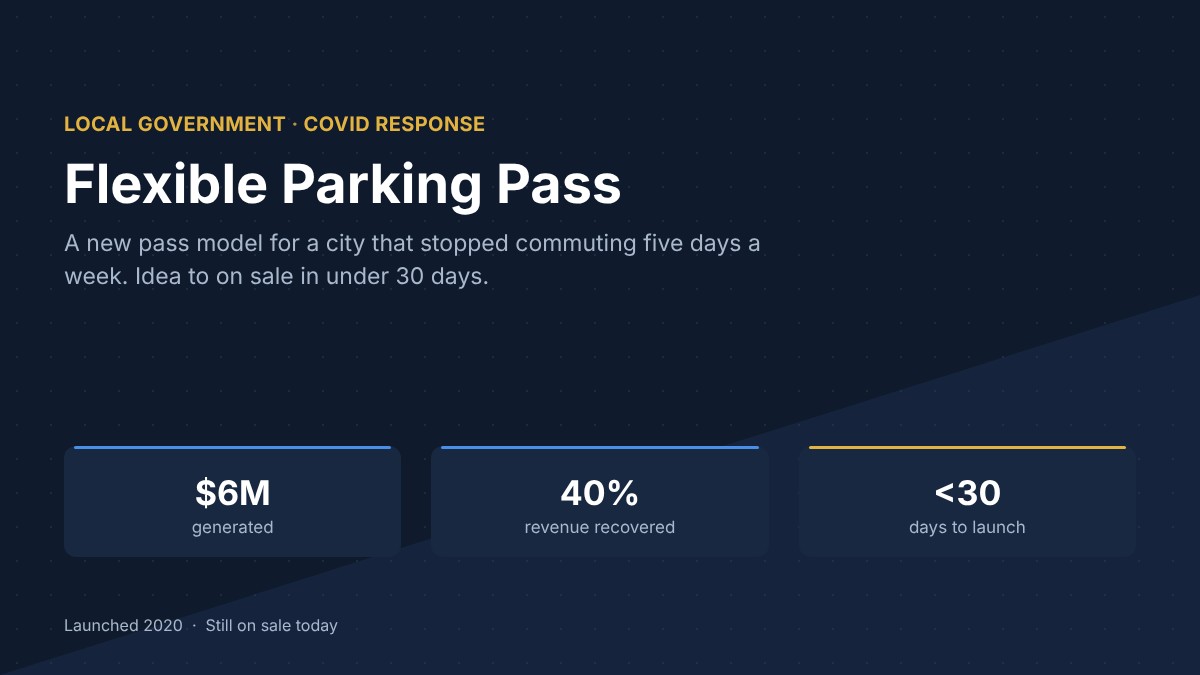
A new parking pass model taken from idea to on sale in under 30 days when COVID broke the five-day commute. Still selling today.
Role
Led product, municipal parking
Industry
CivicTech / Mobility
Client
Local Government
Context
Civic & GovTech
01. The Problem
A Pass Built for a Commute That Vanished
The city's monthly parking pass business assumed a five-day commute. In spring 2020, COVID emptied downtown in a matter of weeks, that assumption collapsed, and pass revenue went with it. Cancellations piled up, and nothing on the shelf fit a customer who now drove in one or two days a week.
This was a public agency with council-level visibility. Waiting out the crisis was not an option, and neither was quietly discounting the existing product.
This was a public agency with council-level visibility. Waiting out the crisis was not an option, and neither was quietly discounting the existing product.
02. The Decision
Reprice the Commute, Don't Discount the Pass
A discount on a monthly pass still asks the customer to pay for days they no longer drive. The fix had to be a different commercial model.
The new pass is that model: a bundle of weekday parking sessions at select parkades, priced well below daily rates, for people who park some days instead of every day. You commit to a month of occasional parking rather than a month of daily parking. It met hybrid commuting where it actually was, years before hybrid work settled into a phrase.
The new pass is that model: a bundle of weekday parking sessions at select parkades, priced well below daily rates, for people who park some days instead of every day. You commit to a month of occasional parking rather than a month of daily parking. It met hybrid commuting where it actually was, years before hybrid work settled into a phrase.
03. Shipping It
Under 30 Days, on Existing Rails
I led the product from idea to on sale in under 30 days. The speed came from scope discipline. The pass launched on the existing parking platform and payment rails rather than waiting for new infrastructure, and every feature that could survive until version two was deferred. Defending that scope to stakeholders who wanted more in the box was most of the product management.
A companion feature supporting downtown businesses through the parking app followed about two weeks later.
A companion feature supporting downtown businesses through the parking app followed about two weeks later.
04. Results
$6M, and a Product That Outlived the Crisis
The pass generated $6M and recovered 40% of the lost pass revenue.
The stronger validation is that it never went away. Years later it is still on sale: ten weekday sessions a month at select parkades, priced about 25% below daily rates.
The stronger validation is that it never went away. Years later it is still on sale: ten weekday sessions a month at select parkades, priced about 25% below daily rates.
Key Insights & Takeaways
- A pricing model is a product. This one was a commercial redesign shipped in thirty days.
- Speed came from scope. Launching on existing rails is what made 30 days possible.
- The best test of a crisis product is whether it outlives the crisis. This one is still on the shelf years later.
Let's Connect
Looking for a similar outcome?
Let's discuss how we can modernize your product operations or accelerate your AI roadmap.