Enterprise Onboarding Is Mostly Waiting: How Client Setup Went From Months to Weeks
Most enterprise onboarding delay is waiting, not work. Here is how client setup went from two months to two weeks, and a 15-minute audit to find the waiting.

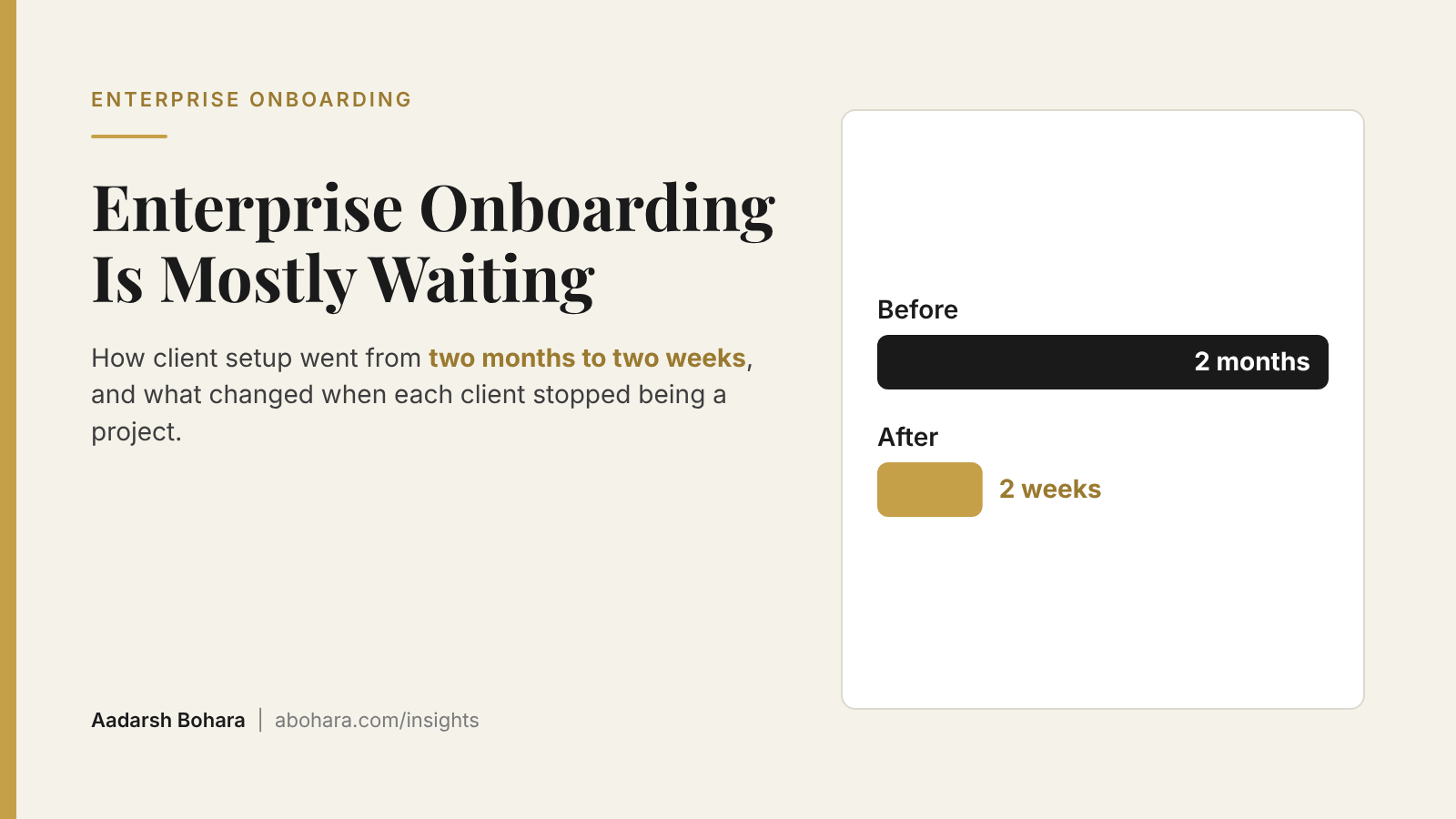
If you ask a team how long enterprise onboarding takes, they will tell you how much work it is. Configuration, data loads, training, a few integrations. Add it up and it sounds like a lot of effort.
Then look at the calendar.
The first time I did that properly was in local government, on the platform behind a city’s parking operations. New client onboarding ran on spreadsheets, and every deployment was a manual project that took about two months.
In my experience, most of a calendar like that is waiting, not work.
The number nobody puts on a dashboard
I call it time to first outcome, a stricter version of what many teams call time to value: the calendar days from a signed contract to the first moment the customer gets the result they paid for. Not the kickoff call. Not the first login. The first real outcome.
It is a strange metric to leave unowned. Sales tracks the signature. Customer success tracks satisfaction. Engineering tracks the tickets. The weeks in between belong to everyone, which in practice means nobody watches them.
When you do watch them, the pattern is consistent. The effort is real, but it is small next to the queue time around it.
Three kinds of waiting
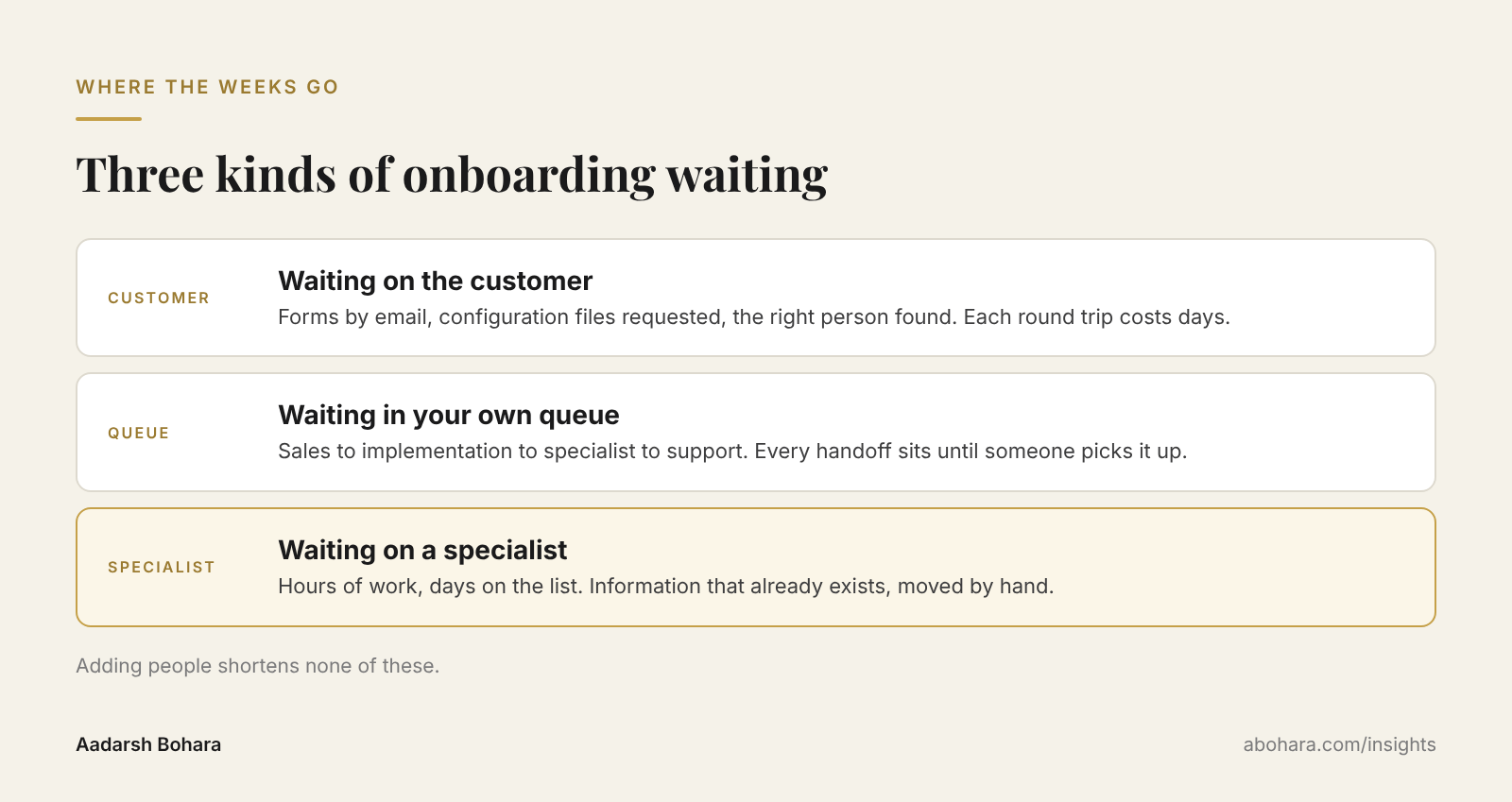
Most onboardings I have worked on had some mix of the same three waits.
Waiting on the customer. A form goes out by email. A configuration file is requested. Someone on their side has to find the person who knows the answer. Each round trip costs days, and the customer rarely knows which answers are blocking you.
Waiting in your own queue. The work passes from sales to implementation to a specialist to support. Every handoff is a ticket that sits until someone picks it up. Four handoffs at three days each is almost two weeks of nothing happening.
Waiting on a specialist doing it by hand. Some steps need a skilled person to assemble a setup from information that already exists somewhere else. The work itself takes hours. Getting onto that person’s list takes days.
Adding people shortens none of these. A bigger team still sends the same email and still waits for the same reply.
What changed on the parking platform
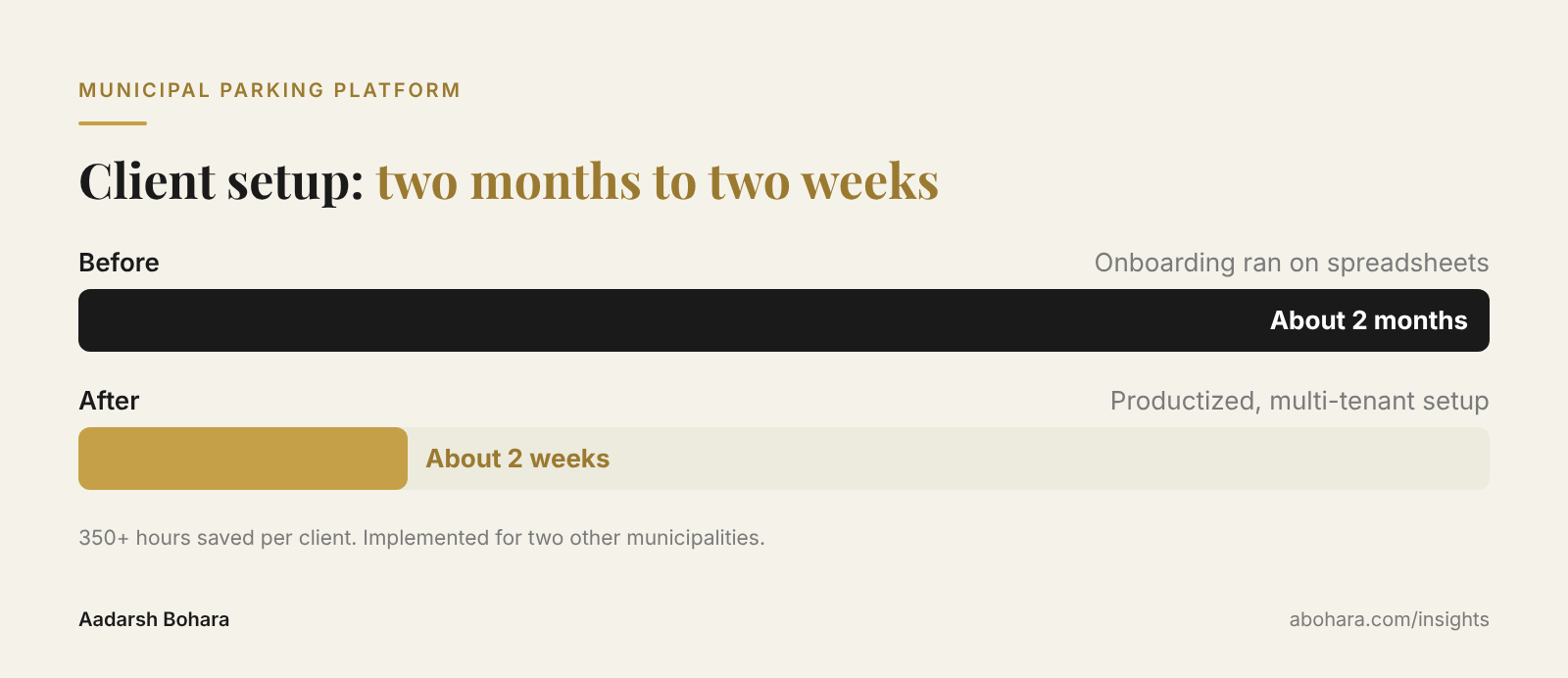
We stopped treating each new client as a project and turned onboarding into part of the product. Setup moved out of spreadsheets into a productized, multi-tenant configuration, so a new client was a set of choices inside the platform instead of a custom build around it.
Client setup went from about two months to about two weeks. That saved more than 350 hours per client. It also changed what the platform was: a single-city system became something other operators could adopt, and we implemented it for two other municipalities.
The lesson I took from it was simple. Onboarding is a product. If it lives in a spreadsheet, it behaves like one.
The same pattern at enterprise scale
In my current role I lead product for a customer identity platform behind more than 200 product lines and roughly 4 million users. Enterprise onboarding there has all three waits, at a much bigger scale.
Self-serve provisioning workflows cut customer onboarding time by 80%. The same principle, removing round trips, shapes how clients set up single sign-on. When an enterprise client wants single sign-on, the fastest path is a setup page they fill in themselves, with their own identity provider details, instead of an email thread that collects the same details one reply at a time.
The third wait, the specialist doing it by hand, is where I am now piloting an AI agent. When an order arrives, it assembles the full entitlement setup and stages it for a delivery specialist to review, edit or commit. That work takes a person two to five hours per order today. The agent does the legwork. The person keeps the decision.
Different fixes for different waits.
The 15-minute onboarding audit
You can find your own waiting without a consultant or a data project. Take one recent customer and do this:
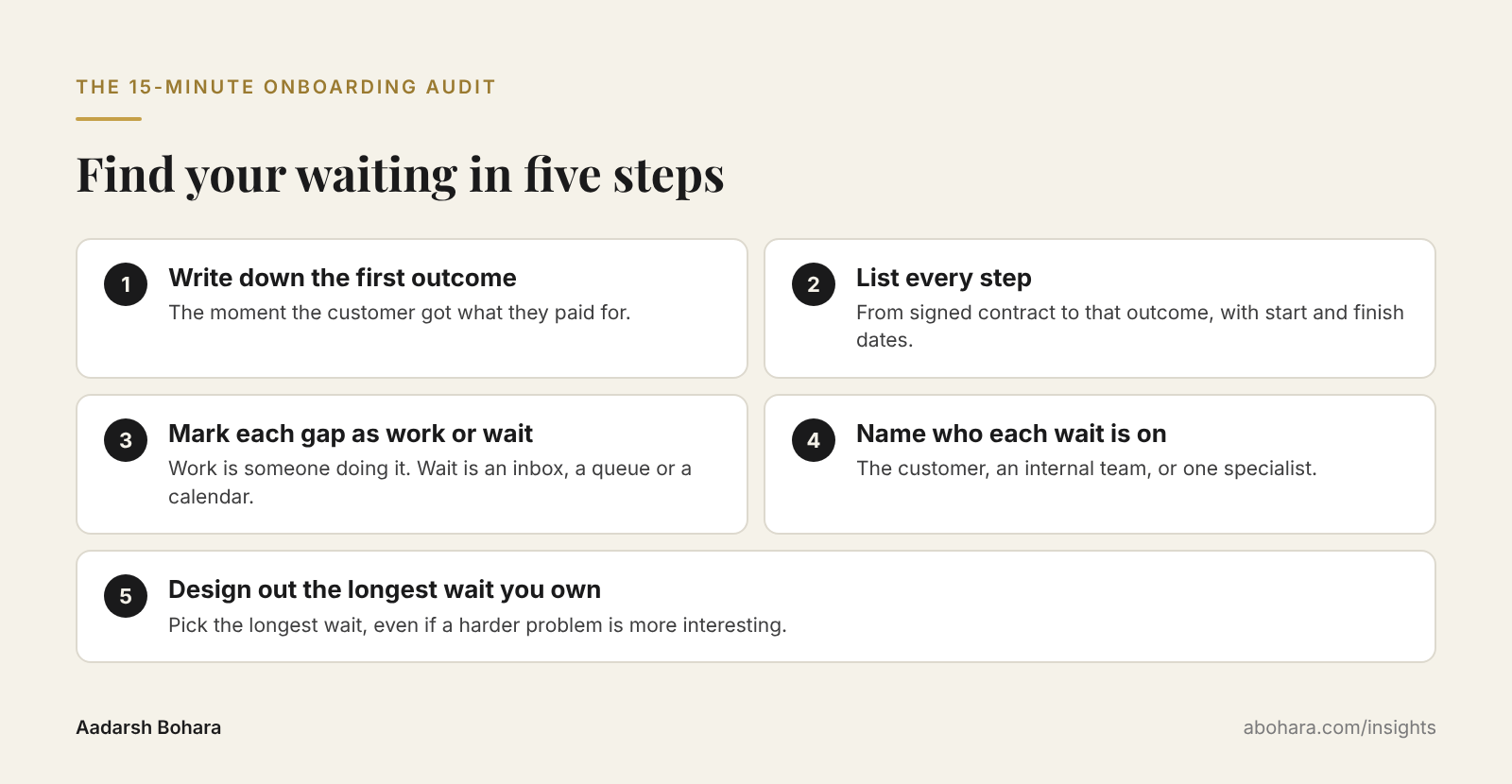
- Write down the first outcome. The moment the customer got what they paid for. Be specific: “the first employee signed in through their own SSO and saw the right products” is an outcome. “Go-live” is a status.
- List every step between the signed contract and that outcome, with the date each one started and finished.
- Mark each gap as work or wait. Work is someone actively doing the step. Wait is the step sitting in an inbox, a queue or a calendar.
- Name who each wait is waiting on. The customer, an internal team, or a specific specialist.
- Pick the longest wait your side owns and design it out. Not the hardest technical problem. The longest wait.
In my experience, the work column comes out as a small fraction of the calendar. Everything else is the opportunity.
What I would tell a product leader
Put time to first outcome on the product dashboard, next to activation and retention. If it only shows up in customer success reviews, product will keep fixing features while customers sit in queues.
Then attack the waits in order. Remove the round trips first, because they cost the customer’s patience as well as your time. Remove handoffs second. Automate the specialist work last, and keep a human on the commit for anything that reaches the customer.
Months to weeks takes no heroics. It takes someone who owns the calendar as well as the tasks.