

Project Vitals
- Role: Founder & Product Architect
- Category: SaaS & Startup Growth
- Strategy: AI-First Automation for SMBs
- Status: Live in Market
1. The Strategic Thesis: Democratizing the “Digital Agency”
Small business owners (Spas, Dental Clinics) are trapped. They know they need “Digital Reputation” to survive, but existing solutions fail them in two ways:
- The “Enterprise Bloat” Problem: Competitors like Podium or BirdEye are priced for mid-market ($300+/mo) and packed with complex features a solo owner never uses.
- The “Agency” Cost: Hiring a human agency costs $1,000+/mo—unaffordable for a local salon.
My Product Vision: Build the “Unbundled Agency.” I set out to build a platform that delivers the outcome of an agency (more reviews, returning customers) without the cost. The strategy was to use Generative AI to act as the “Marketing Manager,” lowering the operational cost to near zero.
2. The Evolution: From “Utility” to “Growth Engine”
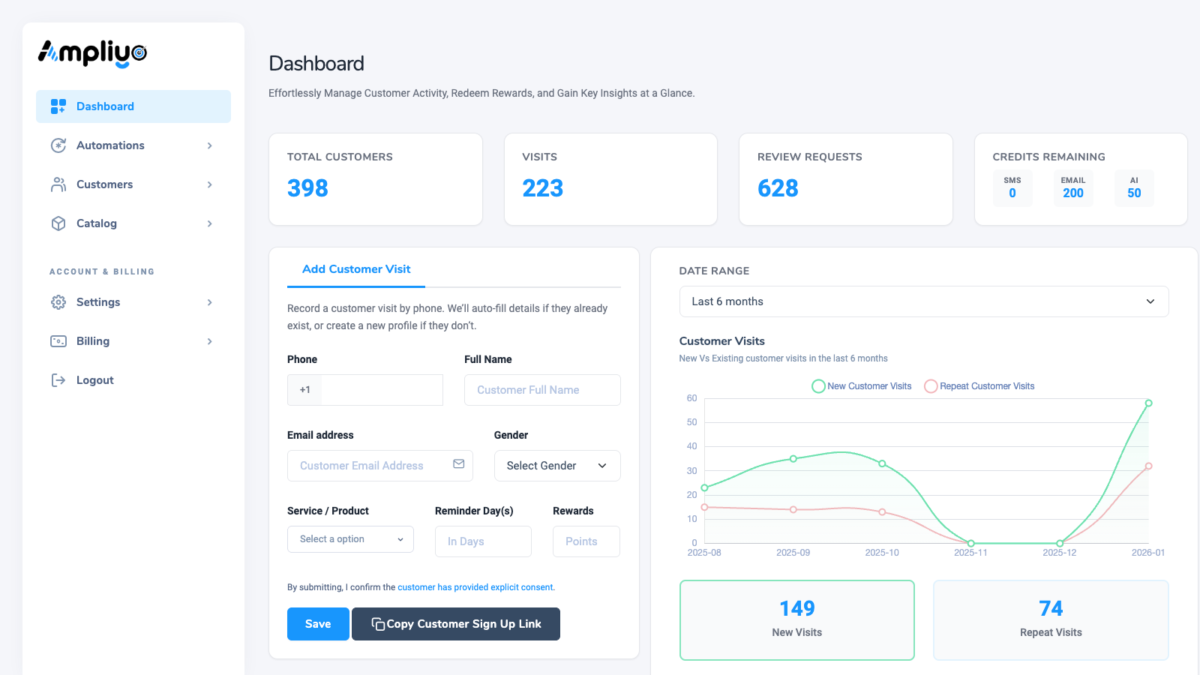
We didn’t build everything at once. The roadmap was dictated by user needs and competitive gaps.
- Phase 1 (The MVP): We launched with Automated Review Collection and the Negative Review Guardian. This solved the immediate “hair on fire” problem (Bad Reputation) and provided instant ROI.
- Phase 2 (Retention & LTV): We realized that getting a review is a one-time event, but a business needs recurring revenue. I expanded the platform to include SMS/Email Marketing and Loyalty Programs.
- The Impact: This shifted the product from a simple “Review Tool” to a full “Customer Engagement Platform,” allowing owners to reactivate dormant clients and increase Lifetime Value (LTV).
- Phase 3 (Intelligence): We added Business Profile Management and deeper AI integration, allowing the system to not just send messages, but to suggest campaign ideas based on regional holidays (e.g., “Mother’s Day Special”).
3. Key Product Decisions & Trade-offs
- Decision 1: “Invisible Software” vs. Dashboard Fatigue
- The Trap: Competitors force users to log in daily to view analytics.
- The Pivot: I designed Ampliyo to be “headless”—it runs in the background. It notifies the owner via SMS only when action is needed. This reduced churn for busy owners who often forget to log in.
- Decision 2: The “AI Guardrails” Strategy
- The Risk: Open access to GPT-4 could spike API costs and produce unsafe content.
- The Fix: I engineered strict prompt templates. Users don’t “chat” with the AI; they select a goal, and the AI fills in pre-structured blanks. This keeps margins healthy and content safe.
4. The Critical Challenge: Platform Dependency
- The “Walled Garden” Risk: Building on top of Google Maps is our single biggest vulnerability. While we successfully built a programmatic workaround to fetch and generate review links (bypassing the need for manual input), we are still blocked from accessing the official Google Reviews Management API.
- The Business Impact: This blockage means we cannot allow users to respond to reviews directly from our dashboard. This degrades our value proposition from “Full Reputation Management” to “Review Acquisition Only.”
- The Lesson: This experience highlighted the fragility of platform-dependent businesses. It forced us to pivot and innovate on Owned Channels (SMS/Email) where we control the infrastructure, ensuring we aren’t solely reliant on third-party ecosystems.
5. Outcome & Future Roadmap
Ampliyo is now live, servicing Spas, Clinics, and Restaurants.
Next Horizon: We are exploring “Agentic AI” to allow the system to auto-schedule campaigns based on local weather or events, further reducing the owner’s workload.
Market Validation: Early users report a 30% increase in Google Reviews within 30 days.
The Pivot to Sales: With the engineering foundation stable, the focus has shifted to GTM (Go-to-Market). My wife now leads the Sales & Marketing motion, allowing me to focus on the technical roadmap.
6. Under the Hood: The Tech Stack
- Core Architecture: PHP (Laravel) & MySQL on AWS.
- Frontend: Custom JS/AJAX with HTML5 (Optimized for mobile speed).
- AI Integration: OpenAI API (GPT-4o) with custom Prompt Engineering & Content Guardrails.
- DevOps & Speed: Built using a “Vibe Coding” workflow (AI-Assisted Development) to reduce dev cycles by 60%.
- Infrastructure: Twilio (SMS/A2P 10DLC), SendGrid (Email), Stripe (Subscription Billing).