

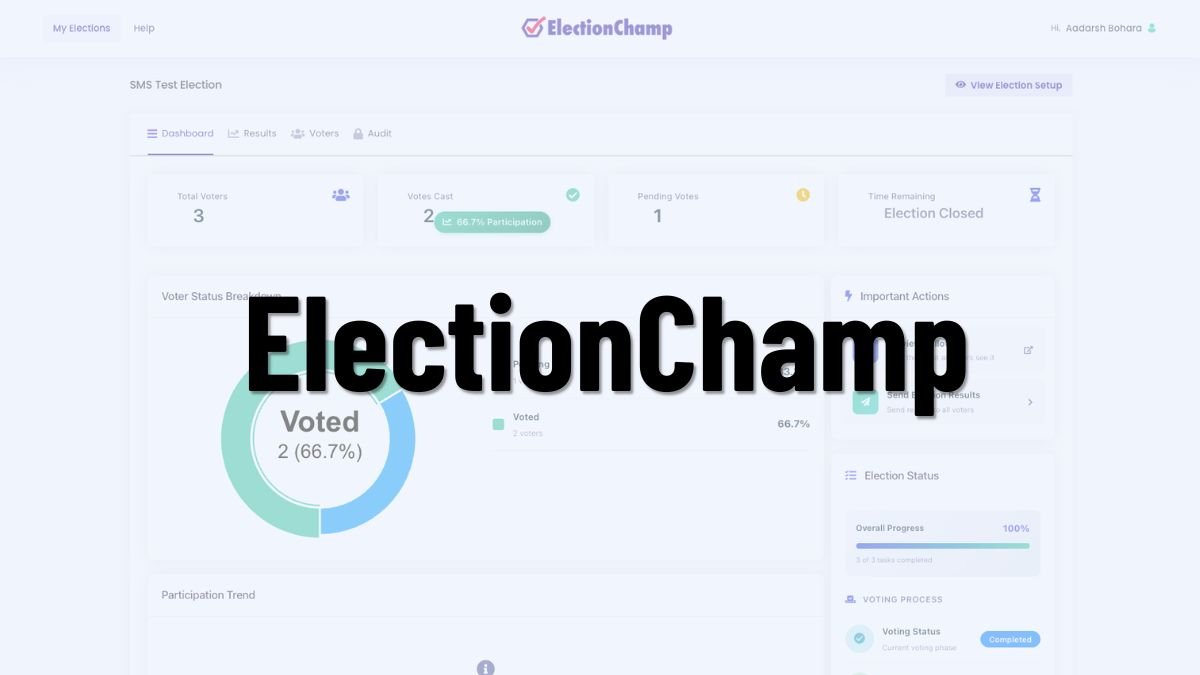
Project Vitals
- Role: Founder & Solo Architect (End-to-End)
- Category: SaaS & GovTech
- Strategy: Trust Engineering & Privacy by Design
- Status: Live in Market
1. The Strategic Thesis: The “Integrity Gap”
After spending years in the e-voting space (formerly at ElectionBuddy), I stepped away for three years. In that time, I observed that the industry was stagnating. Platforms were secure against hackers but often failed to protect voters from internal bias (e.g., admins snooping on results in real-time).
The Vision: I returned to the market to build ElectionChamp, a competitor designed from the ground up to close these gaps. My goal was to build a platform where Voter Privacy is mathematically enforced, not just promised.
2. Execution: The 0-to-1 Solo Build
I operated as the sole engineer and designer for the entire ecosystem. This wasn’t just a backend build; I delivered the complete product lifecycle:
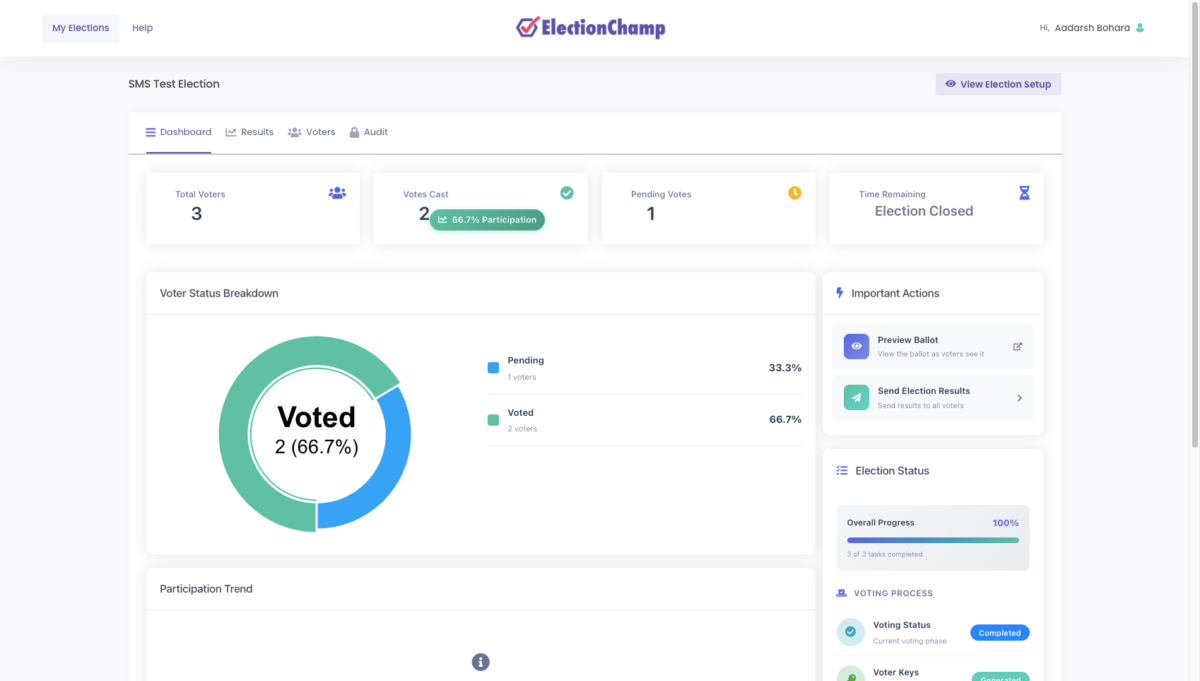
- The Core Platform: Architected and coded the complex voting logic, encryption protocols, and admin dashboards from scratch.
- The Growth Engine: Designed and built the public-facing Marketing Website, focusing on SEO and conversion optimization to compete with established players.
- The Velocity: By operating as a solo developer with a modern stack, I was able to out-pace legacy competitors in shipping new features like AI integration.
3. Trust Architecture: “One Person, One Vote”
Security in voting isn’t about passwords; it’s about non-repudiation and anonymity. I engineered a “Trustless” authentication system:
- The 16-Char Entropy Key: Instead of reusable logins (which are vulnerable to credential stuffing), every voter is generated a unique, high-entropy 16-character hash.
- The “Burn” Protocol: The moment a key is used to cast a ballot, it is cryptographically “burned” (invalidated). This prevents double-voting attacks even if the user attempts to replay the session.
4. “Privacy by Design”: Protecting Voters from Admins
A critical flaw in many voting systems is that Election Administrators can deduce who voted for whom by watching the real-time feed. I built an Anti-Surveillance Protocol to solve this:
- The “Masking” Algorithm: The system intentionally hides the status of the last 3 voters and randomizes the voter list display.
- The Impact: This effectively “blinds” the administrator. Even if they have the database logs, they cannot correlate a specific timestamp to a specific vote, ensuring true anonymity.
5. The AI Implementation: Structured Generation
Most forms in GovTech are tedious to build. I integrated OpenAI to automate the setup process, but with a strict engineering constraint: Structure over Text.
- The Challenge: A ballot isn’t just text; it’s logic (Plurality vs. Ranked Choice).
- The Solution: I engineered a “Schema-Enforced” prompt pipeline. When a user asks the AI to “Create a Board of Directors ballot,” the AI returns a validated JSON object, which is instantly parsed by our API handler to render a fully functional ballot.
6. Audit & Compliance
To serve HOAs and Unions, “Trust” must be visible. I built a granular Immutable Audit Log:
- Voter Forensics: We log IP addresses and timestamps for every cast ballot.
- Admin Watchdog: Uniquely, we also track the Admin’s behavior. If an Admin views the results or the voter list too frequently, it is flagged in the log, creating a “Paper Trail” that discourages tampering.
7. Tech Stack
- Core: PHP/Laravel, MySQL (Relational Integrity).
- Frontend: Custom JS/AJAX & Responsive Marketing Site.
- Security: SHA-256 Hashing, Entropy Key Generation.
- AI: OpenAI API (JSON Mode).